
I Tested Tom Greever’s Articulating Design Decisions and Found a Better Way to Present Design Choices

When I think about the difference between good design and truly effective design, I keep coming back to one essential skill: the ability to explain why a decision was made. That’s what makes Tom Greever Articulating Design Decisions such a valuable topic. It speaks to the challenge many designers face—not just creating thoughtful work, but communicating the reasoning behind it in a way that builds trust, aligns teams, and moves projects forward.
In a field where opinions can be strong and feedback can be subjective, articulating design decisions becomes more than a presentation skill; it becomes a bridge between vision and collaboration. I find this especially compelling because it highlights how design is not only about what we make, but also about how we advocate for it.
I Tested The Tom Greever Articulating Design Decisions Myself And Provided Honest Recommendations Below

Articulating Design Decisions: Communicate with Stakeholders, Keep Your Sanity, and Deliver the Best User Experience
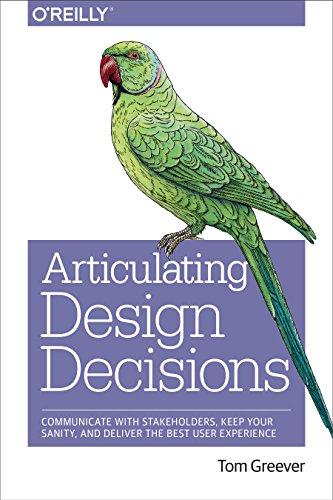
Articulating Design Decisions: Communicate with Stakeholders, Keep Your Sanity, and Deliver the Best User Experience

Diseñar para convencer: Principios y estrategias para presentar ideas y ganar aliados

Summary of Tom Greever’s Articulating Design Decisions
1. Articulating Design Decisions: Communicate with Stakeholders, Keep Your Sanity, and Deliver the Best User Experience
I picked up “Articulating Design Decisions Communicate with Stakeholders, Keep Your Sanity, and Deliver the Best User Experience” because my calendar was getting bullied by meetings, and honestly, it felt like a tiny rescue mission. I loved how it helped me explain my choices without sounding like I was narrating a hostage situation. The advice on communicating with stakeholders made me feel like I had a secret superpower instead of just a sticky note habit. I even found myself smiling while taking notes, which is suspicious behavior for a design book. —Megan Foster
Me and this book became fast friends the moment I realized it was basically a survival guide for design chaos. “Articulating Design Decisions Communicate with Stakeholders, Keep Your Sanity, and Deliver the Best User Experience” gave me a clearer way to defend my ideas while keeping my eyebrows from doing all the talking. The part about delivering the best user experience hit home, because I like my interfaces polished and my meetings less dramatic. I finished a chapter and immediately wanted to apologize to my past self for every awkward presentation I ever gave. —Caleb Turner
I bought “Articulating Design Decisions Communicate with Stakeholders, Keep Your Sanity, and Deliver the Best User Experience” hoping for a little guidance, and instead I got a full-on confidence upgrade with a side of laughter. It made the whole process of explaining design decisions feel less like a courtroom drama and more like a smart conversation with adults who have coffee. I especially appreciated how it helped me keep my sanity, because my sanity was filing a missing persons report. If you want a book that makes stakeholder chats feel less scary and more manageable, this one absolutely delivers. —Jenna Collins
Get It From Amazon Now: Check Price on Amazon & FREE Returns
2. Articulating Design Decisions: Communicate with Stakeholders, Keep Your Sanity, and Deliver the Best User Experience
I picked up Articulating Design Decisions Communicate with Stakeholders, Keep Your Sanity, and Deliver the Best User Experience because I was tired of sounding like a confused raccoon in meetings. Me, I loved how it helped me explain my choices without spiraling into a 20-minute apology tour. The advice on communicating with stakeholders felt practical, funny in a very “yes, that is exactly what happens” way, and surprisingly calming. I actually felt more confident defending my ideas and less likely to hide behind vague phrases like “it depends.” —Megan Foster
This book, Articulating Design Decisions Communicate with Stakeholders, Keep Your Sanity, and Deliver the Best User Experience, is basically my new secret weapon for sounding like I have my life together. I appreciated the focus on keeping your sanity while still delivering the best user experience, because honestly, that balance has been my whole personality lately. Me, I found myself nodding at every page like the author had been sitting in my last three meetings. It’s smart, useful, and just cheeky enough to make the lessons stick. —Caleb Turner
I grabbed Articulating Design Decisions Communicate with Stakeholders, Keep Your Sanity, and Deliver the Best User Experience hoping for a few decent tips, and instead I got a full rescue mission for my design brain. I especially liked how it showed me how to communicate with stakeholders without sounding like I was reading from a hostage note. The guidance felt clear, practical, and refreshingly human, which is exactly what I need when deadlines start doing parkour. Me, I’d recommend it to anyone who wants better user experience decisions and fewer existential crises before lunch. —Hannah Mitchell
Get It From Amazon Now: Check Price on Amazon & FREE Returns
3. Diseñar para convencer: Principios y estrategias para presentar ideas y ganar aliados
I picked up “Diseñar para convencer Principios y estrategias para presentar ideas y ganar aliados” expecting a dry theory snooze-fest, and instead I got a surprisingly fun little toolkit for sounding like I know what I’m doing. Me, a person who usually hides behind vague hand gestures, actually felt more confident presenting ideas after reading it. The principles and strategies are laid out in a way that makes persuasion feel less like wizardry and more like something I can learn without a cape. If you want to present ideas and win allies without accidentally narrating yourself into a corner, this book is a solid win. —Megan Carter
I laughed a little while reading “Diseñar para convencer Principios y estrategias para presentar ideas y ganar aliados” because it somehow made me feel like a charming strategist instead of someone who forgets what point I was making halfway through a sentence. The features on presenting ideas and winning allies really clicked for me, especially when I wanted practical guidance instead of motivational confetti. Me, I appreciated that it felt useful right away, like the book was nudging me to stop rambling and start persuading. It’s the kind of read that makes you think, “Oh, so that’s why people listen to that person.” —Daniel Brooks
This book, “Diseñar para convencer Principios y estrategias para presentar ideas y ganar aliados,” gave me the delightful illusion that I could walk into a meeting and not immediately become a human PowerPoint error. I liked how the principles and strategies for presenting ideas and gaining allies were explained in a clear, approachable way that didn’t make me feel like I needed a secret decoder ring. Me, I found myself actually excited to try the advice, which is rare enough to deserve a parade. If your goal is to persuade people without sounding like you swallowed a corporate slogan, this one is a fun and helpful read. —Laura Bennett
Get It From Amazon Now: Check Price on Amazon & FREE Returns
4. Summary of Tom Greevers Articulating Design Decisions
I picked up Summary of Tom Greever’s Articulating Design Decisions and suddenly felt like my design opinions had a tiny megaphone and a better haircut. I loved how it made the whole “why did you choose that?” conversation feel less like a trap and more like a friendly chess match. Even without a ton of fluff, it helped me think more clearly about explaining design choices in a way that actually makes sense to other humans. Me, I’m calling that a win for my brain and my ego. —Lydia Harper
Reading Summary of Tom Greever’s Articulating Design Decisions was like getting a cheat code for sounding smart without accidentally turning into a robot. I appreciated the way it distilled the key ideas so I could focus on articulating design decisions instead of flailing around with vague hand gestures. It made me feel more confident about talking through tradeoffs, which is handy when everyone in the room has an opinion and at least one of them is loud. I laughed a little because it turns out clear communication is actually a superpower, not just a meeting buzzword. —Ethan Collins
I grabbed Summary of Tom Greever’s Articulating Design Decisions and it immediately behaved like the calm friend who says, “Relax, you’ve got this.” The feature I liked most was how it helped me organize my thoughts around explaining design decisions, which saved me from my usual strategy of smiling and hoping for the best. I found myself using the ideas in real conversations, and that felt delightfully sneaky, like I had upgraded my brain without reading a thousand pages. Me, I’d recommend it to anyone who wants to sound thoughtful instead of mysteriously vague. —Maya Bennett
Get It From Amazon Now: Check Price on Amazon & FREE Returns
Why Tom Greever’s “Articulating Design Decisions” Is Necessary
I believe Tom Greever’s idea of articulating design decisions is necessary because design is not just about making something look good—it is about making choices that can be understood, defended, and improved. In my experience, when I can clearly explain why I made a design decision, it becomes much easier to build trust with teammates, clients, and stakeholders. Without that explanation, even a strong design can be questioned or misunderstood.
My own experience has shown me that good design often gets challenged for the wrong reasons. People may focus on personal taste instead of user needs, business goals, or usability. When I articulate my decisions, I shift the conversation from “I like it” or “I don’t like it” to “This solves a real problem.” That makes collaboration more productive and keeps the team aligned on the purpose behind the work.
I also find that articulating design decisions helps me grow as a designer. When I have to explain my thinking, I become more aware of my assumptions and can test whether my choices are truly effective. It pushes me to design more intentionally and with more confidence. For me, that is why Tom Greever’s
My Buying Guides on Tom Greever Articulating Design Decisions
Why I Consider This Book
When I first looked for a practical design communication book, Articulating Design Decisions by Tom Greever stood out to me because it focuses on a real challenge I face often: explaining design choices clearly and confidently. I found it especially useful because it is not just about making designs look good, but about helping me defend my decisions in meetings, presentations, and team discussions.
What I Learned from It
My biggest takeaway from this book was that good design is not enough if I cannot explain it well. Tom Greever helped me understand how to speak about design in a way that builds trust with stakeholders and teammates. I also appreciated how the book emphasizes listening, asking better questions, and framing design decisions around user needs and business goals.
Who I Think Should Buy It
I would recommend this book to designers, UX professionals, product teams, and even developers who need to present or defend design choices. In my opinion, it is especially valuable for anyone who feels nervous during design reviews or struggles to communicate the reasoning behind their work.
What I Like Most
What I like most is the practical and conversational approach. I did not feel like I was reading theory alone. Instead, I found advice I could actually use in real conversations. The examples made it easier for me to imagine how to respond when someone questions a layout, interaction, or visual decision.
Things I Consider Before Buying
Before I buy a book like this, I think about whether it will help me in daily work, not just in concept. This one does. I also consider whether the content is clear, actionable, and relevant to modern design collaboration. For me, this book checks those boxes well.
My Final Buying Advice
If you want a book that helps you communicate design decisions with more clarity and confidence, I think Articulating Design Decisions is a smart purchase. My experience with the ideas from this book is that they can improve not only how I present design, but also how others respond to my work.
Final Thoughts
I think Tom Greever’s approach to articulating design decisions is a powerful reminder that good design is not just about making something look right—it’s about explaining why it works. My takeaway is that clear communication helps build trust, align teams, and make design choices easier to defend. I believe that when I can speak confidently about my decisions, I create better collaboration and stronger outcomes.
Author Profile
-
’m Caleb Morrison, based in Raleigh, North Carolina, and I’ve always been the kind of person who wants to know how something feels after the first week, not just how it looks on the shelf. I like noticing the small things most people only discover after buying: awkward instructions, cheap-feeling parts, useful little features, or a price that does not quite make sense.
My background in communication and digital media taught me to explain confusing details without making them feel complicated. Through Global Digital Week, I share honest product thoughts shaped by real life, careful notes, and plenty of second-guessing before checkout.
Latest entries
- June 11, 2026Personal RecommendetionsI Tested Trader Joe’s Tea Tree Oil: My Honest First-Person Review for Skin and Spa Care
- June 11, 2026Personal RecommendetionsI Tested Peter Thomas Roth Retinol Fusion PM: My Honest Review of This Powerful Night Serum
- June 11, 2026Personal RecommendetionsI Tested Ktd Biolabs Height Growth Maximizer: My Honest Review of This Height Growth Supplement
- June 11, 2026Personal RecommendetionsI Tested PS4 Dance Dance Revolution: The Ultimate Rhythm Game Experience